Showing posts with label Discussion. Show all posts

8/20/2012

16th Street Community Design Workshop, Rescheduled Oct, Sep 13, 1 to 5 pm, Hice Hall, Mia Bch Community Church


Flamingo Park Neighborhood Association
City of Miami Beach – Capital Improvement Projects
Sixteenth Street Improvement Program
Community Design Workshop Meeting

Saturday, September 15, 2012, 10:00 am
Saturday, October 13, 2012, 1:00-5:00 pm,
Hice Hall, Miami Beach Community Church
1620 Drexel Avenue, South of Lincoln Road

The Flamingo Park Neighborhood Association announces that it will host a Community Design Workshop Meeting to consider community input regarding the design of the Sixteenth Street Improvement Program, to be held on Saturday, September 15, 2012, 10:00 am, at Hice Hall, Miami Beach Community Church, 1620 Drexel Avenue, just south of Lincoln Road.

The purpose of this Design Workshop Session is to review, discuss, and develop community consensus on the further Design Development of the 16th Street Improvement Project.  Issues to be addressed include: 
  • Goal and Objectives of the Sixteenth Street Improvement Program
  • Review of Existing 30% Plans; Review Survey of Existing Conditions
  • Assure the narrowing of the street width of North / South Avenues
  • Encroachments [Policy; Contributing vs. Diminishing]
  • Configuration of the Right of Way -- sidewalk, swale, parking, bike lane, travel lane street furniture zone
  • Green space
  •  Landscaping, Lighting, and Signage
  • Inquiry into the difference between area north of Espanola and south of Espanola

 Target Participants -- invited to attend and participate include --


Residents, Property Owners and other Stakeholders of Sixteenth Street
Residents, Property Owens and other Stakeholders of the Neighborhood
Residents, Property Owens and other Stakeholders of the City
Representatives of CIP Department, Public Works Department, and Other City Staff


12/09/2011

Flamingo Park Neighborhood Association adopts NO CASINOS FLORIDA RESOLUTION !

Dear Mayor Bower and Commissioners:

The Flamingo Park Neighborhood Association at its meeting on December 5, 2011 by unanimous vote adopted the following / attached No Casinos Florida Resolution.

NO CASINOS FLORIDA RESOLUTION

WHEREAS the Florida Legislature is currently considering various measures that would provide for the substantial expansion of gambling, and

WHEREAS the legislation being considered would allow for casino operations that rival in size and scope the gambling operations that exist in Las Vegas and Atlantic City, and

WHEREAS notwithstanding the assurances of gambling promoters, historically, large scale casino operations cannibalize non-gambling businesses causing, for instance, the shuttering of forty percent of all restaurants and one-third of all retail businesses in Atlantic City, and

WHEREAS our community will have to bear the severe and painful economic and social costs that always accompany expansive gambling, including the misery of individuals and families touched by problem gambling as they are at higher risk of divorce, bankruptcy, child abuse, domestic violence, crime, and suicide, and

WHEREAS expanded gambling will assuredly bring corruption of the governmental process as immensely wealthy gambling companies from all over the world seek to receive benefits from the local and state governments that regulate their existence and profits, and

WHEREAS full scale casino and gambling expansions will became commonplace throughout our community and our state, if the gambling interests are allowed to obtain major casino expansion, and

WHEREAS inward facing mega-developments will privatize public streets, destroy the pedestrian experience of our downtown, exacerbate traffic and denigrate the quality of life in our community, and

WHEREAS the false promises of increased revenue and jobs, like the broken promises that accompanied the lottery and other gambling expansions, are intended to convince Floridians to make a fools gamble with their future.

BE IT RESOLVED that the FLAMINGO PARK NEIGHBORHOOD ASSOCIATION through this Resolution urges the Florida Legislature to reject any and all expansions of gambling, including legislation to legalize so-called “destination casinos” in Florida.


Adopted by unanimous vote on December 5, 2011


11/13/2010

On Our Agenda -- Proposed Re-zoning of The Temple House Would Preclude Entertainment Use

From: Cineo
Date: November 13, 2010 5:10:27 PM EST
To: Denis Russ
Subject: FPNA Meeting

Dear Mr. Russ:

My many thanks for your time earlier.  As a follow-up to our conversation, please find below the language that resulted from a meeting with Mr. Lorber (Zoning and Planning) and Mr. Gomez (Assistant City Manager).  Our collective objective was to find a way to recognize the "highest and best" use of the property (which for over 70 years served as an assembly area) as well as be mindful of the needs and desires of the residents.  

The language, while quite restrictive, is something that I can live with.  In short it would allow, subject to approval by both Commission and the Planning Board, NON-ENTERTAINMENT assembly use of the space for such things as the showing of art, education lectures, seminars and presentations.  Again, what is important to note here is that even with Commission approval, I will still need to sit before the Planning Board for their support as well.

The language reads....

(9)        Notwithstanding (7) and (8) above, bed and breakfast inns that have had historic prior assembly use may be permitted to have limited non-entertainment (entertainment as defined in section 142-1361) assembly uses (such as art showing, corporate seminars, educational lectures and presentations) if approved by the Planning Board as a conditional use subject to the following limitations:

a)         Consisting of private events by invitation only, and

b)         Not open to members of the general public, and


c)         Ending no later than 11:30 PM, and

d)         Invite must indicate no street parking.  Guests must be directed to city parking lots or licensed private parking lots.

e)         No delivery shall occur before 9:00 AM or after 5:00 PM during weekdays, and

f)          No delivery shall occur before 10:00 AM or after 3:00 PM during weekends.


As an aside, the definition of "entertainment"  (section 142-1361 of the Miami Beach City Code) is as follows:  "Entertainment means any live show or live performance or music amplified or nonamplified. Exceptions: Indoor movie theater; big screen television and/or background music, amplified or nonamplified, played at a volume that does not interfere with normal conversation."

Because the language specifically precludes entertainment, it would mean no live shows, performances, etc.   I've highlighted the additional reason for including the language, which is to insure that nothing would interfere with normal conversation.

Again, I believe that this language is fair for all, and provides a use of the building that will prevent its deterioration by allowing it to be self-sufficient and offset the extraordinary costs associated with mortgage, taxes, insurance and maintenance.

I hereby respectfully seek the support of the Flamingo Park Neighborhood Association. 

My many thanks,

Daniel


Daniel Davidson
1415 Euclid Ave.
Miami Beach, FL 33139
P - 786-280-6565
F - 305-673-5175

9/27/2010

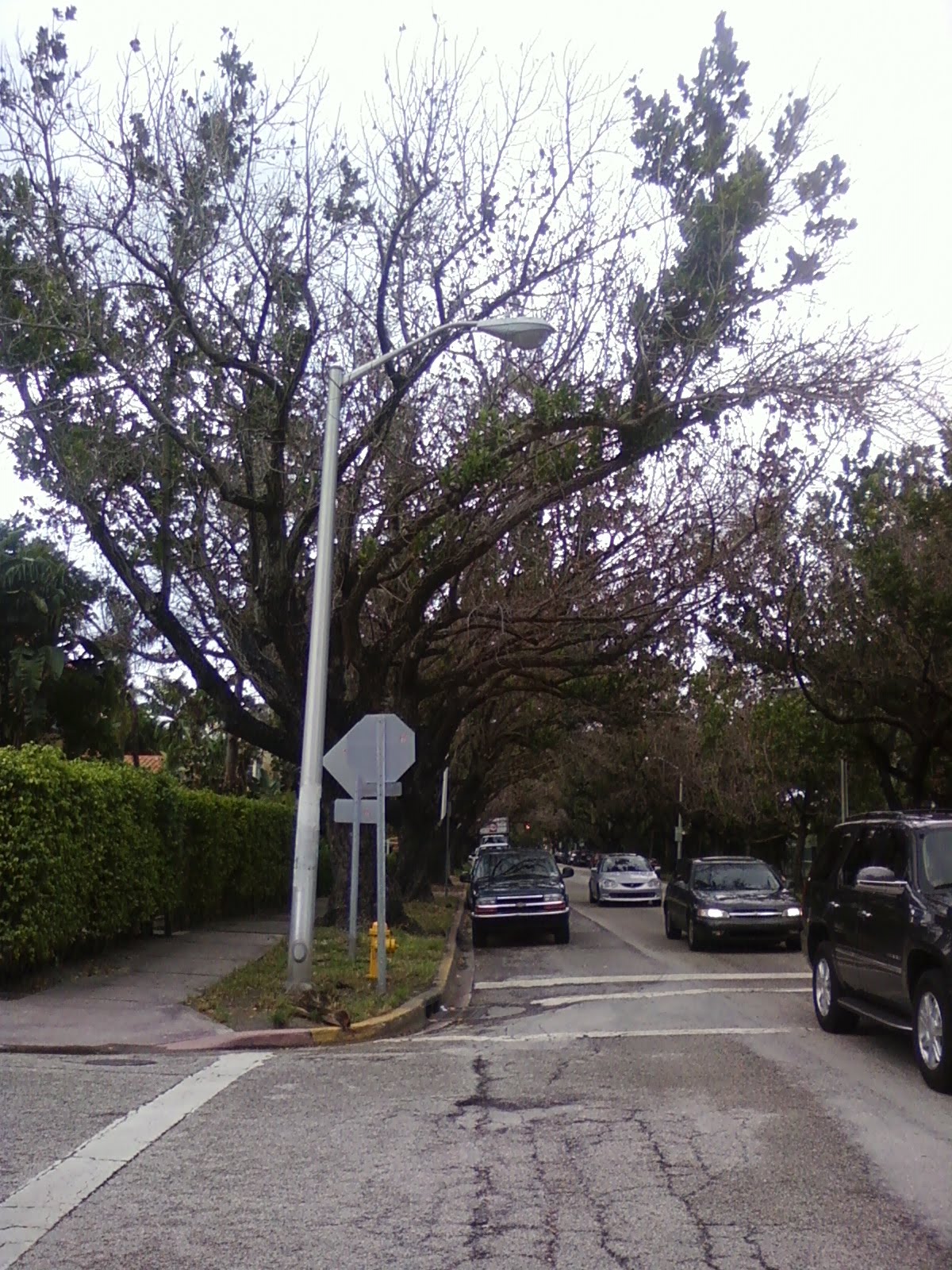
Meridian Avenue Tree Canopy - An Update

Chris Latt, City of Miami Beach Urban Forester, sent the following email to update the Neighborhood Association regarding their plans for the Calophyllum trees on Meridian Avenue damaged by last winter's cold weather.

"The Parks and Recreation Department sent a Letter to the Commission (LTC) on [the] subject [of the Meridian Avenue tree canopy] to the City Commission in July, and remains very aware of and concerned about these trees. I will update and expand on the information in the LTC. The duration of the cold weather last winter was unprecedented, at least within the memory of most people, and this had results that could not be anticipated or prevented. The Parks and Recreation Department has five International Society of Arboriculture certified arborists on staff. We are members of the Tropical Arborists Guild, a South Florida professional organization that includes the region's top tree experts, including arborists and horticulturists from Fairchild Tropical Garden, Montgomery Botanic Garden, Vizcaya, Pinecrest Garden, and Jungle Gardens, as well as municipal arborists, University of Florida Extension personnel, tree company owners, and working arborists. This group has centuries of combined experience with the trees of S. Florida, but everyone was surprised by the extent of this year's damage to the region's calophyllum trees (the species on Meridian Ave.). A number of members remembered the record low temperatures of the 1970s, but did not see damage of this extent on calophyllum trees. The duration of the cold weather made the difference.

As stated in the LTC, the trees on Meridian Ave. were fertilized to ensure they had the necessary nutrients to support new growth. Our strategy was to wait a full growing season before we removed any possibly dead branches, so the trees would have as much time as necessary to produce new growth. When the LTC was written, most of the Meridian Ave. trees were producing new buds and shoots on the bare branches. It now seems that production of new shoots has stopped or slowed, so we may not get much more new growth. The new shoots should continue to grow and fill-in the crowns, but it appears that many branches are dead or unable to produce new shoots. These will need to be trimmed. We will delay trimming until at least the end of this year or perhaps until next spring. Growing conditions are still favorable so it is possible that we will still get some new growth this year. The argument in favor of waiting until spring is that when branches are cut back, this can trigger shoot production from the cut branch ends. The new shoots are tender and can be killed by cold weather, so it would be safer to wait until spring when the risk of cold weather is past. Ms. Tibbles mentioned the risk of breaking branches. The large branches, even if they are dead, will retain strength for several years so are a low risk of failure. Small branches, when they dry out can break in heavy winds, but even these will take time before they lose strength. Since these branches lack leaves to catch the wind, they will not be moved or bent as much as live branches by the wind, reducing the risk of breakage. I don't think these branches will present a big risk between now and spring. We will notify the neighborhood association before tree trimming starts."

2/04/2010

Our Colleague, Wanda W. Mouzon, shares the following discussion on the role of the Sidewalk -- urban amenity vs. social equity

Sidewalks: Conflict and Navigation Over Public Space
By Anastasia Loukaitou-Sideris and Renia Ehrenfeucht
MIT Press, 2009, 341 pp., hardcover $28
Review by Philip Langdon

Sidewalks in Anaheim, California, legally need be only four feet wide — which is too narrow for couples to pass each other while strolling. Los Angeles requires sidewalks at least five feet wide, which is more comfortable. Oakland mandates a six-foot minimum.

Some cities have extensive guidelines aimed at making the sidewalks a pedestrian-friendly public environment. Others cities do relatively little in that regard. In just about every respect, sidewalks are treated in very different ways from one municipality to another.

Sidewalks: Conflict and Negotiation over Public Space, by Anastasia Loukaitou-Sideris of the UCLA Department of Urban Planning and Renia Ehrenfeucht of Planning and Urban Studies at the University of New Orleans, is described by its publisher as the first book-length analysis of the sidewalk as a distinct social space. It traces the historical evolution of sidewalks in the US, examines conflicts that have arisen over their competing uses, and discusses some of the municipal standards now applied to these public rights-of-way.

Long ago, Jane Jacobs and William H. Whyte showed how city sidewalks could be useful, enjoyable, sociable parts of neighborhoods and downtowns. The authors of this new book are not oblivious to enjoyment and sociability, but they seem more concerned about how to create “a just city.” This leads them in directions that will disconcert quite a few readers. Loukaitou-Sideris and Ehrenfeucht want people to think about whether panhandling should be allowed, whether the homeless have a right to sleep in public spaces, and whether protesters have an overriding right to demonstrate, among other issues.

They contend that activities currently prohibited by some cities or business improvement districts — such as asking for money or sleeping on the sidewalk — cause discomfort for middle-class people but do not inflict harm on anyone. Indeed, the authors at times suggest that seeing distressed homeless individuals may be useful because it can motivate people to solve a social problem. Perhaps so, but the argument seems one-sided. We know for sure that when sidewalks accommodate too much troubling activity, those who have choices stay away. The city becomes a dismaying place. Its economy is hobbled. It’s hard to see how this ends up being anything other than bad for most of a city’s inhabitants, the homeless included.

Loukaitou-Sideris and Ehrenfeucht oppose design interventions that might cause “the nonconsuming public” to feel it is being excluded from public spaces. They point out that some cities, in encouraging sidewalk dining, have either allowed café owners to place fences around outdoor areas or have mandated them. “Whereas in Paris the private space of the café blends seamlessly into the public space of the sidewalk, in US cities, fences create an abrupt border,” they observe. Some cafes and restaurants in this country “extend their control over public space” by posting signs that order people not to skateboard, loiter, tie their dogs to the fence, or engage in other forms of “inappropriate behavior” on the sidewalk, the authors say.

The book contains a moderately interesting chapter on “sidewalk as urban forest,” which looks at how cities deal with street trees. On the whole, though, Sidewalks seems geared more to social justice advocates than to people who are trying to bring vitality and prosperity to urban locales.