Arts in the Parks: Romeo & Juliet
February 12-13, 3:00 p.m.
Flamingo Park, Meridian Avenue and 12 Street
Ground Up & Rising presents Shakepeare's Romeo & Juliet
Showing posts with label Flamingo Park. Show all posts
Showing posts with label Flamingo Park. Show all posts
2/10/2011
Romeo and Juliet in Flamingo Park; In Preparation for Valentine's Day!!
1/10/2011
Sad news about our friend and neighborhod, Arturo Bosch
I was wondering if you knew Arturo Bosch and his dog Aloha. He was the king of Flamingo park basically and was always on top of things, making sure the park was functioning properly and complaining to the City of Miami Beach about crosswalks, the lights, etc. He was a true activist and a great great man.
With deep sadness I must let you know that Arturo passed away last Thursday January 6th. We, all those who knew him and cared about him, are deeply affected. His family will he holding a memorial for him sometimes next week. I will let you know.
Please let those who knew him know.
Thanks, Soraya (Flamingo Park neighbour)
11/20/2010
CMB Commission Land Use Committee, Mon, Nov 22nd, 4pm, in City Manager's Conference Room, About the Skate Park in Flamingo Park
Land Use Committee
Mon, Nov 22, 4pm, in the City Manager's Conference Room
At its meeting on Wednesday the City Commission referred the Flamingo Park Skate Facility to its Land Use Committee for Discussion. The matter has been placed on the Agenda for Monday, November 22nd at 4:00 pm in the City Manager's Conference Room.
The Flamingo Park Neighborhood Association has been clear in opposition to the location of a Skate Park in Flamingo Park.
When the City Commission included a Skate Park in the Masterplan and the Administration initiated the design process we began to develop guidelines to proceed with a Skate Plaza rather than a Skate Park. The Plaza would be more low key, suitable for young and new skaters, and incorporate trees and grassy areas instead of being a solid mass of concrete with features that would create a regional attraction.
I totally agree with Jack's good advice in making a strong effort to present ourselves in solidarity and making remarks as individuals rather than as spokesman for Flamingo.
11/18/2010
CMB Land Use Committee will meet Monday to consider Skate Facility in Flamingo Park
Land Use Committee
Mon, Nov 22, 4pm, in the City Manager's Conference Room
At its meeting on Wednesday the City Commission referred the Flamingo Park Skate Facility to its Land Use Committee for Discussion. The matter has been placed on the Agenda for Monday, November 22nd at 4:00 pm in the City Manager's Conference Room.
It is timely for the Land Use Committee to give guidance on the program and vision for the Skate Facility.
As we move into the design process I agree with Wanda that while its apprpriate for us to guard that vision we also want to participate in a collegial and flexible way -- along with the design professionals, CIP and Parks & Recreation Staff. and other stakeholders.
Flamingo Park Neighborhood Association Nov 18, 2010 Draft
The Skate Plaza in Flamingo Park
Description – should be designed to provide a safe and enjoyable family oriented recreational opportunity for wheeled sports for Miami Beach youth of all ages.
The Flamingo Park Skate Plaza might well be one of a series of such skate spots or skate plazas that would give young and new skaters a place to learn, practice, and cut their teeth, so to speak.
While Miami Beach could pursue development of a Skate Park elsewhere, that was not the vision of the City Commission for Flamingo Park. An advanced recreational facility with unique elements not found elsewhere in South Florida would become a regional attraction and should not be located within our residential area.
Design Guidelines –
• appropriate for Neighborhood Park, not a world class facility that becomes a regional attraction and neighborhood nuisance;
• examine opportunities to include skatable art;
• discourage high speed / high elevation;
• aim at a skate circuit / path rather than more randomly placed unorganized group of elements on a large slab of concrete.
A skate plaza is designed for street skateboarding by incorporating urban terrain elements such as benches, rails, stairs and ledges of varying difficulty. Unlike most modern day skate parks that consist of stark vertical ramps, and bowls, the skate plaza resembles a public square in a town or city by incorporating landscaping and art to create a multi-use park that is aesthetically pleasing.
Elements -- no bowl, no quarter pipes, no half pipes; steps or stairs, rails, ramps and benches should be of appropriate height, perhaps no higher than 2 feet;
Landscaping -- landscaped surroundings and integrated shaded landscaping incorporated within the skateboard facility. Aim for an appropriate hardscape to landscape ratio, perhaps of 3:1 or 2:1 as determined desirable.
Operation / Maintenance -- not fenced, not supervised; not lit; free of charge.
Friends of Flamingo Park
Nov 18, 2010 Draft
Skate Facility -- Design Guidelines
The new skate plaza will be designed to provide a safe and enjoyable family oriented recreational opportunity for Miami Beach youth of all ages. The design philosophy will be in keeping with the overall vision of the park as an open, accessible, area. Furthermore, the skate plaza will be dotted with patches of green space.
Our skate plaza will incorporate the favorite features of an urban skater like stairs, rails, curbs, and ledges while still retaining a landscaped park-feel which is aesthetically pleasing. Unlike most modern day skate parks that consist of one large block of concrete and bowls, the skate plaza resembles a public square in a town or city by incorporating landscaping.
Our skate plaza will be a skater and park user oasis, serving a dual purpose for skate boarders enjoyment and exercise, and when not in use a desirable place to stroll through or sit and rest under a tree. Our skate plaza will be further enhanced with skate-able art, an appealing feature and an opportunity to showoff our unique South Beach personality.
Design Guidelines of Flamingo Skate Plaza:
* include steps, stairs, ramps, rails, benches no more than 2 feet high.
* no bowl, no half pipe, no quarter pipe
* a path with continuous flow to allow skater to complete a full circuit
* mostly ground level, with minimal elevated features not to exceed 2 feet
* no fence
* free of charge
10/13/2010
Flamingos will march in the Veterans Day Parade
Veterans Day Parade and Picnic
Thursday, November 11, 2010
Perhaps you would like to join the Flamingos marching in the Veterans Day Parade on Thursday, Novembeer 11, 2010, from 9 to 11 am, culminating with a picnic celebration in Flamingo Park! Please contact Scott Needelman, who serves as our Flamingo Parade Marshall, SAN1455@ATT.net or Telephone 305-710-5584.
The Veterans Day Parade will begin at 9:00 am. Participants will line up along Convention Center Drive from 17th Street, marching east on Seventeenth Street to Washington Avenue and then south along Washington to Eleventh Street. They will then head west along 11th Street to Flamingo Park. There will be a brief ceremony in the park followed by a free picnic for all participants.
Commissioner Jerry Libbin has rallied support for the parade and picnic, noting "The men and women who serve our country with distinction deserve our appreciation every day. This event gives us an opportunity to come together as a community to thank them."
The wreath laying ceremony and 21-gun salute at Flamingo Park will begin at approximately 10:30 am following the parade. A moment of silence will be observed at 11:00 am in honor of the First World War Armistice Day tradition. Immediately following Commissioner Libbin will be hosting a picnic for parade participants.
Flamingo Parade Marshall -- Scott Needelman
SAN1455@ATT.net or Telephone 305-710-5584
10/06/2010
Join us in Planning for the Veterans Day Parade, Meeting on Mon, Oct 11, 5:30pm, at The Seymour -- with the Parade Just A Month Away
Monday, October 11, 2010, at 5:30pm
Meeting at The Seymour, 945 Pennsylvania Avenue
Veterans Day Parade and Picnic -- November 11, 2010
Scott Needleman invites all those interested in participating in the Veterans Day Parade to meet on this Monday, October 11th, at The Seymour to make plans for the Parade and help design a banner for the Flamingo Neighborhood Association that can be used for the parade and for other similar events and activities.
All residents of the Flamingo Neighborhood are encouraged to attend and participate in a day of commemoration and celebration that will culminate in the Commissioner Jerry Libbin Picnic to be held in Flamingo Park.
The Flamingo Neighborhood Association has agreed to participate in the day's activities. Since the route will go right through our neighborhood and be highlighted by the picnic in Flamingo Park, it's a great opportunity to increase our outreach in the community.
9/27/2010
Meridian Avenue Tree Canopy - An Update
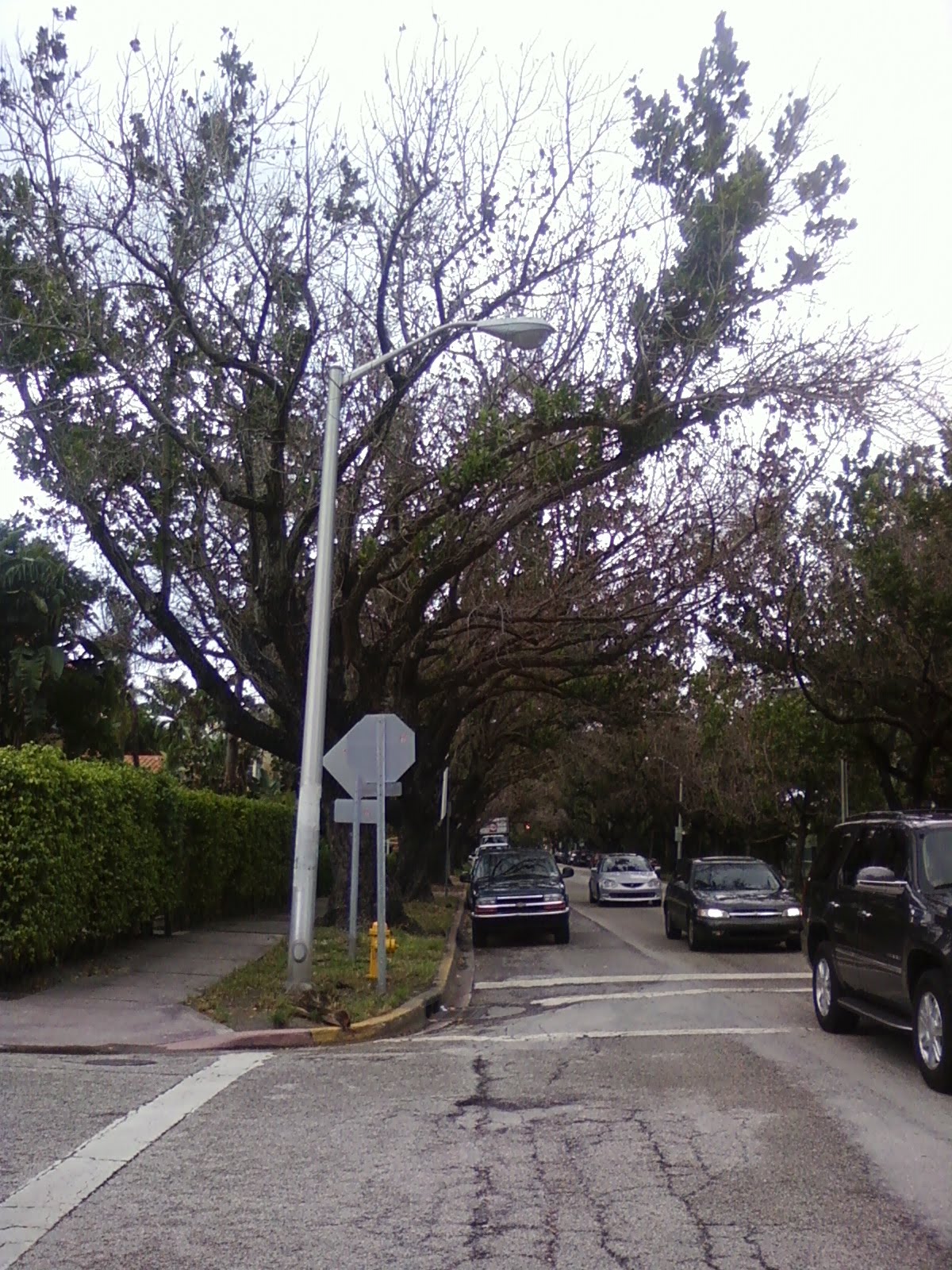 Chris Latt, City of Miami Beach Urban Forester, sent the following email to update the Neighborhood Association regarding their plans for the Calophyllum trees on Meridian Avenue damaged by last winter's cold weather.
"The Parks and Recreation Department sent a Letter to the Commission (LTC) on [the] subject [of the Meridian Avenue tree canopy] to the City Commission in July, and remains very aware of and concerned about these trees. I will update and expand on the information in the LTC. The duration of the cold weather last winter was unprecedented, at least within the memory of most people, and this had results that could not be anticipated or prevented. The Parks and Recreation Department has five International Society of Arboriculture certified arborists on staff. We are members of the Tropical Arborists Guild, a South Florida professional organization that includes the region's top tree experts, including arborists and horticulturists from Fairchild Tropical Garden, Montgomery Botanic Garden, Vizcaya, Pinecrest Garden, and Jungle Gardens, as well as municipal arborists, University of Florida Extension personnel, tree company owners, and working arborists. This group has centuries of combined experience with the trees of S. Florida, but everyone was surprised by the extent of this year's damage to the region's calophyllum trees (the species on Meridian Ave.). A number of members remembered the record low temperatures of the 1970s, but did not see damage of this extent on calophyllum trees. The duration of the cold weather made the difference.
 As stated in the LTC, the trees on Meridian Ave. were fertilized to ensure they had the necessary nutrients to support new growth. Our strategy was to wait a full growing season before we removed any possibly dead branches, so the trees would have as much time as necessary to produce new growth. When the LTC was written, most of the Meridian Ave. trees were producing new buds and shoots on the bare branches. It now seems that production of new shoots has stopped or slowed, so we may not get much more new growth. The new shoots should continue to grow and fill-in the crowns, but it appears that many branches are dead or unable to produce new shoots. These will need to be trimmed. We will delay trimming until at least the end of this year or perhaps until next spring. Growing conditions are still favorable so it is possible that we will still get some new growth this year. The argument in favor of waiting until spring is that when branches are cut back, this can trigger shoot production from the cut branch ends. The new shoots are tender and can be killed by cold weather, so it would be safer to wait until spring when the risk of cold weather is past. Ms. Tibbles mentioned the risk of breaking branches. The large branches, even if they are dead, will retain strength for several years so are a low risk of failure. Small branches, when they dry out can break in heavy winds, but even these will take time before they lose strength. Since these branches lack leaves to catch the wind, they will not be moved or bent as much as live branches by the wind, reducing the risk of breakage. I don't think these branches will present a big risk between now and spring. We will notify the neighborhood association before tree trimming starts."
9/21/2010
Fix A Feline - Sunday at Flamingo Park
| ||

9/10/2010
Our Neighbor and Colleague, Wanda Mouzon, has creaded a website for Freinds of Flamingo Park; Check out our Site and Join in Membership!
Access the site at
http://www.FriendsofFlamingo.org/FOF/Welcome.html
This site is dedicated to Flamingo Park, a beautiful 34.5 acre, grassy, tree-lined park located at 999 11th Street in the heart of South Beach. The facilities provide for many sports as well as passive activities. There is an Aquatic Center with a large swimming pool, lap lanes , a water playground for kids, concession stand and large umbrellas for those who prefer the shade. Next to the pool is the tot lot and playground. There are two Bark Parks, two full Basketball courts, Handball and Racquetball courts, a Tennis Center with pro shop, Football stadium with a track, Soccer and Softball fields, and the Miami Beach Police Athletic League building. Newly planned additions to the park are the Community Garden and a Skateboard Park. Finally there is also free parking for the park located just off of 11th Street.
8/12/2010
Celebrate the Beginning of the School Year at Flamingo Park’s Back to School Bash
Celebrate the Beginning of the School Year at Flamingo Park’s Back to School Bash
Miami Beach, FL Summer’s almost over and what better way to celebrate the beginning of the new school year than with a carnival? The City of Miami Beach Parks and Recreation Department will be hosting their “Back to School Bash” at Flamingo Park, 12th Street and Michigan Avenue, on Friday, August 20, 2010 from 6:00 pm – 9:00 pm.
Children and adults of all ages are invited to enjoy an evening of FREE carnival rides, entertainment, arts and crafts and lots of fun! Tickets will be available for purchase for a chance to win prizes at our carnival games and concessions will be sold.
Look for future events and other Miami Beach Parks and Recreation programming in your Recreation Review magazine, call CMB Parks and Recreation offices at 305-673-7730 or visit our website at www.miamibeachparks.com.
5/09/2010
City Commission to Decide on Tennis Courts in Flaming; An Open Letter to the Mayor and Commissioners
Dear Mayor and Commissioners:
The Flamingo Park Neighborhood Association urges that you move forward by finalizing and implementing the Flamingo Park Masterplan and its Tennis Facilities within the 17 court footprint adopted by the City Commission, approved by the Historic Preservation Board, and recommended by the City Manager.
We fully support the very good plan that resulted from over 18 months of meetings, workshops and hearings guided by Wolfberg Alvarez, CIP, Parks and Recreation, your Finance Committee, and the City Commission.
We fully support the Administration’s analysis and recommendation to move forward now within the parameters of the existing adopted masterplan.
We urge you to fashion a reasonable, realistic solution that will enable tennis players – whether seniors, adults, or our students – to play on appropriate surfaces on courts in the City. But tennis facilities in Flamingo Park ought not to overwhelm other aspects of the park – active, passive or aesthetic. That was the point made by Planning Department staff and the Historic Preservation Board in considering the Berger Plan and the 22 court proposals!
We urge that you fashion a solution without compromising the balance of uses and aesthetic value of the Flamingo Park Masterplan.
Sincerely,
Denis Russ
For Flamingo Park Neighborhood Association
5/06/2010
Commission Meeting Scheduled to Discuss Flamingo Park Tennis -- Let them know: Seventeen is ENOUGH
At the City Commission meeting on Wednesday, May 12, 2010, Item R9K is a Discussion of Amending the Flamingo Park Master Plan relative to the Tennis Center -- including the number and composition of the tennis courts, the design of the clubhouse and the total footprint to the new tennis facility.
The Administration memo can be accessed at http://flamingomb.org/2Q2010/CMB_Flamingo_Tennis_Courts_5-12-2010.pdf
The conclusion and recommendation of the Administration is
A determination of the type and number of courts to be built is needed in order to proceed with this project. We are at 100% drawings on the 17 courts and have been unable to proceed pending a final decision on the number and type of courts to be built. A change in the configuration of the tennis center (and tennis center building design) will require new design drawings to be developed and further costs and delays for the implementation of the Master Plan. The Administration recommends affirming/approving the current Tennis Center design and location and the current footprint of 17 courts. A final decision on the complement of hard versus clay courts will allow us to proceed with the next steps in the project.At our meeting on Monday, May 3, 2010 the Flamingo Park Neighborhood Association reaffirmed our support for the currently approved configuration / footprint of 17 tennis courts. Please take a moment to write a note to the Mayor and Commissioners in support of our position and be sure to show up at the Commission meeting -- Seventeen is ENOUGH.
5/03/2010
Wanda Mouzon sends the message to City Hall: Diversity of Activites and Design Aesthetic Should Guide
Dear Mayor Bower and Commission,
I just read this interesting article and wish to share it with you. The statement that I found especially relevant to our Park renovation and our cause for the preservation of open green space is this:
" Studies show that depression correlates with the lack of access to green space, a plight of many inner-city residents; the physical isolation of suburbanites; and the immobility enforced on those who cannot drive but have no transportation alternative."
http://www.miller-mccune.com/health/how-urban-planning-can-improve-public-health-11408/
Let's not allow the disease of sprawl to infect our City OR our Neighborhood Park! The ad hoc aggregation of single-use projects and functions in a city OR in a park are contrary to creating communities that are socially diverse, environmentally sensitive and economically sustainable. Just as sprawl consumes land, is unsustainable, favors social inequality and causes traffic problems, allowing Flamingo Park to be largely consumed by single-use activities will do the very same thing!
Thank you for keeping this in mind as the final decisions are made concerning the Park. Please remember as well, the design elements and components that create the most beautiful and most enjoyable parks in the world. (that I shared with you all in an earlier email) These two items should be the key deciding factors.
Wanda Mouzon
How Urban Planning Can Improve Public Health
Miller-McCune Online
News and Options
April 28, 2010
A growing movement looks to change development patterns — as a matter of public health.
By Jonathan Lerner
Atlanta's Broad Street is often cited as an instance of urban planning that worked to created a sense of neighborhood.
(Courtesy of Congress for the New Urbanism)
You hardly need scientific research to pinpoint objectionable aspects of suburban sprawl. The big-box commercial jumble, the lifeless cul-de-sac subdivision, the traffic, the sameness — all are plain to see. Disagreeable qualities of half-empty downtowns and deteriorated city neighborhoods are equally visible. Still, people don’t usually think that the things they find aesthetically objectionable about their neighborhoods might literally be making them sick.
Yet a growing mass of scientific evidence does indicate that how places are designed and built can cause and complicate grave health problems for individuals and whole populations. Depression — the clinical kind, not the aesthetic and cultural malaise that sends people vacationing to, say, Barcelona — is one. Studies show that depression correlates with the lack of access to green space, a plight of many inner-city residents; the physical isolation of suburbanites; and the immobility enforced on those who cannot drive but have no transportation alternative.
As for cars, they don’t just spew pollution and trap people alone for wasted hours. They cause accident injuries and deaths. Moreover, unwalkable distances and the culture of automobility encourage sedentary habits, contributing to obesity and diabetes and other illnesses. Plowing up farmland for new subdivisions at the metropolitan edge not only diminishes local food supplies and reinforces industrial agriculture — with negative implications for nutrition and resource conservation — it also forces those who must “drive till they qualify” for housing to need a car for almost every household member. Those automobile costs, usually overlooked, have exacerbated soaring rates of foreclosure and suburban poverty, with unhealthful knock-on effects like stress, displacement and homelessness.
Many examples beyond these lead to a conclusion: The crucial questions about how we build focus less on aesthetics — important as that is to our well-being — than on public health, in its broadest sense.
City planning originated, around the turn of the last century, out of concerns over health problems created by filthy slums and industries. Then the fields of public health and planning came uncoupled. Public health took on a mainly biomedical focus on individual genetics, biology and behavior and how clinicians could affect those, and on a narrowly biological approach to epidemiology and evidence. Meanwhile the planning of built environments was hijacked by the car.
Now the fields of city planning and public health — pushed by economic crisis, climate change and green technology, among other factors — are converging again. This month, the Congress for the New Urbanism was set to hold its national convention in Atlanta; it was organized with help from the Centers for Disease Control and Prevention under the theme “New Urbanism: Rx for Healthy Places.”
The convention is hardly the first effort to address the relationships between urban form and health. The World Health Organization’s Healthy Cities movement was initiated in 1988; among other things, it encourages attention to health inequalities, participatory governance and the health considerations of economic and urban development. Some 1,200 European cities and many in Canada and Australia participate.
Back in the U.S., the Local Government Commission, an organization of elected and community leaders, government staff and planners and architects, adopted the Ahwahnee Principles for Resource-Efficient Communities in 1991. (The principles were named for the Yosemite National Park lodge where they were agreed to). The principles targeted the dysfunctional qualities of sprawl-pattern development; these ideas came to underlie the New Urbanism and Smart Growth movements. Meanwhile, The Robert Wood Johnson Foundation’s Active Living Research program supports extensive research into the urban form/public health nexus. The CDC’s Healthy Community Design initiative does the same.
Dr. Howard Frumkin, special assistant to the CDC director for climate change and health and co-author of Urban Sprawl and Public Health: Designing, Planning, and Building for Healthy Communities, actually calls the Congress for the New Urbanism “a public health group. By promoting walkability, mixed use, connectivity and civic space within communities, we know more and more, based on emerging evidence, that CNU is promoting public health.”
To anyone who thinks the New Urbanism makes sense, research conclusions on how built environments affect health can seem self-evident. For example, studies have demonstrated that neighborhoods with shops, schools, libraries, workplaces and homes within easy walking distance tend to support higher levels of physical activity and have lower rates of obesity. Public transit use has a similar effect on activity and fatness. Research has indicated that exposure to nature may improve attention deficit hyperactivity disorder in children, and that people with access to parks exercise more.
Like, duh. “So much research is proving the obvious,” says Ellen Dunham-Jones, associate professor of architecture and urban design at Georgia Tech and co-author of Retrofitting Suburbia: Urban Design Solutions for Redesigning Suburbs. “But once you get the numbers, you can hopefully get policy changes.”
Research into the connection between urban life and public health is, however, also creating surprises. As an example, Dunham-Jones points to studies showing that compact communities reduce overall vehicular emissions — but that people who live next to highways and heavily trafficked arterial roads breathe in more emissions. “It may be healthy for the community at large but not for you,” she says.
Pinning down the implications of such research subtleties remains a challenge. Frumkin identifies two still-poorly understood correlatives of built environment: “We have reason to believe that community design and building design have impacts both on mental health and on social capital. Social capital in turn is a very important determinant of overall health.”
The plans for New Urbanism towns sometimes depict circles centered on retail areas, with radii labeled as the distance of a five- or 10-minute walk. But landscape architect Dee Merriam, a CDC community planner, says that even walkability, a seemingly unambiguous value, needs scrutiny. “The basic metric we’ve been using for urban design has been the automobile scale, and the walking scale is a totally different metric,” she says. “What is the distance of a five-minute walk? It’s probably very different for a young athlete than for an elderly woman or someone with toddlers.”
Merriam says more investigation is also needed into green space, despite its known health connections; Dunham-Jones agrees, saying that research has raised complex questions about trade-offs. “Cities would prefer to have one big central park to maintain, than to have a whole lot of little parks. To really get people jogging, you need a big park. But to get little kids to go play, it’s much better to have a lot of little parks,” she says. “We can improve health by doing all sorts of things, but we’re not at the point where we’re maximizing dollar investment.”
Some new efforts to find design solutions for health challenges involve food. Ideas range from turning abandoned space in declining neighborhoods into urban farms — projects like this are already under way in Detroit and elsewhere — and allotting space for community gardens in new developments. There is even a vision of “agriburbia,” where entire neighborhoods are landscaped with orchards and cropland that could feed people in and beyond the development while providing local employment opportunities.
A recent design workshop addressed another piece of the healthy living puzzle: multigenerational or “lifelong” communities, where people can continue to live actively as they grow old. Specialists on aging, developers, planners and architects tried to envision the transformation of parts of metro Atlanta, reiterating the “must-haves” of New Urbanism — transit and walkability, mixed uses, multiple housing types — but describing how such elements could better accommodate the aging with, for example, shorter walking distances and shuttles to transit stops and shopping areas.
So the Congress for the New Urbanism, the CDC and others are taking important steps to address the cause-and-effect relationships of built environment and public health. But for towns and cities to be less damaging to health, those connections must become more universally acknowledged by health professionals, designers, planners and the decision-makers and developers for whom they work. Moreover, for the environment to support better health, public consciousness has to change. Individual choices will have to sustain healthier patterns of development, and political support will be needed, too, because some of the proposed changes in development demand big cultural shifts, particularly around auto use.
Many advocates say what’s needed is a holistic view that considers health, the environment, social relations, political processes and the economy as part of the development process. Jason Corburn, associate professor of city and regional planning at University of California, Berkeley, and author of Toward the Healthy City: People, Places, and the Politics of Urban Planning, insists that architects and planners “need to recognize that they’re part of governance,” since a healthy city should invite open participation in its political processes, planning included. “This is not to say that design is not important,” he says, but that it should be just one piece of thinking relationally about multiple influences upon health.
One tool that helps government officials identify such influences is the health impact assessment, an evaluation
process similar to the environmental impact statement. Such health assessments are a relatively new phenomenon in the U.S., but several dozen have already been conducted, and the CDC is actively promoting their use. While there is a legal basis under environmental protection laws for evaluating health impacts of proposed projects, the officials responsible are often unfamiliar with the HIA concept, or can feel that it deals in types of evidence not traditionally considered valid in making development decisions.
But traditional thinking has produced the sickening built environments most Americans now inhabit. Even “progressive” ideas won’t necessarily change them. For example, if everybody owned a car that drove 100 miles on a gallon of gas, the country would burn less oil — but sprawl would still be encouraged, and the population would continue to grow fatter, sicker and more isolated. It may be possible to influence the public to choose transit over cars; entrenched attitudes toward tobacco were changed after all. But to change transport habits, America needs to provide transit systems and walkable destinations as practical options, and that’s where the architects and planners come in.
Subscribe to:
Posts (Atom)